 How-to
How to Make a Natural Fiber Wall Hanging as a Beginner
Last Updated: November 1, 2026
Quick Summary
A natural fiber wall hanging is made by knotting cotton cord onto a wooden dowel. Beginners need only a dowel, about 3 to 4 mm cotton cord, scissors and a measuring tape, and can finish a small piece in an afternoon by learning the square knot first.
- Use 100% cotton cord about 3 to 4 mm thick for a forgiving first project.
- Cut eight cords, each about 10 feet long, so the finished piece hangs evenly.
- Learn the square knot, which takes about 15 to 20 minutes to feel natural.
- Buy about 10 percent more cord than you calculate, since beginners often cut cords too short.
- Keep cotton hangings indoors away from direct sun and moisture, since they weaken outdoors.
Table of Contents
- What You Need to Make a Natural Fiber Wall Hanging
- Choosing Natural Cotton Macramé Cord for Your First Project
- Easy Macramé Knots for Beginners to Learn First
- Step-by-Step: Making a Beginner Macramé Wall Hanging
- Finishing, Trimming, and Caring for Your Cotton Piece
- How to Hang a Macramé Wall Hanging Safely
- Start Your First Wall Hanging With Stitched Creations Supplies
- Frequently Asked Questions
What You Need to Make a Natural Fiber Wall Hanging
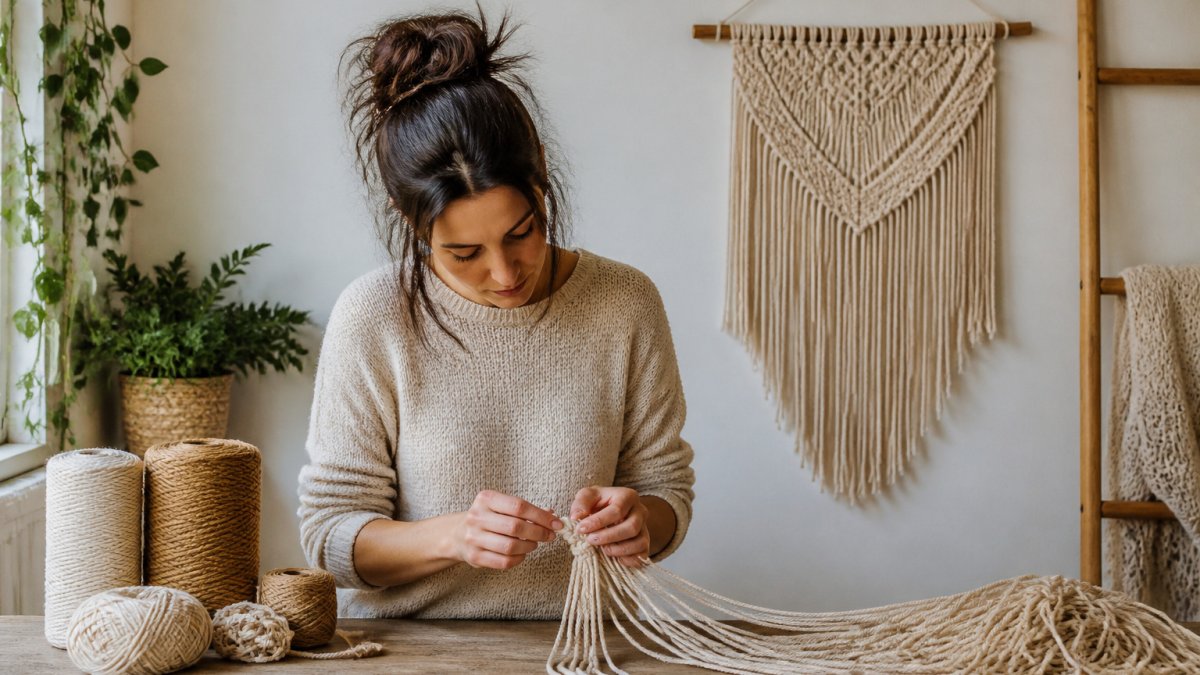
Making your first natural fiber wall hanging is simpler than most people expect. You need only a few basic supplies, and you can finish a small piece in an afternoon. The steps below show exactly how to do it.
Here is what to gather before you start:
- A wooden dowel or driftwood branch, about 16 to 24 inches long
- Natural cotton cord, roughly 3 to 4 mm thick
- Sharp scissors
- A measuring tape
- A clothespin or small clip to hold cords while you work
- A cord-free flat surface, such as a table with a towel over it
You do not need special tools. Most people already own everything except the cord and the dowel. Plan on buying a little extra cord. Beginners often cut a cord too short.
Choosing Natural Cotton Macramé Cord for Your First Project
Cotton cord is the most forgiving choice for a first project. It is soft, easy to knot, and holds its shape well. It also comes in natural, undyed tones that suit almost any room. Our Stitched Creations pieces are crafted with eco-friendly materials, and natural cotton is a popular choice for its soft, warm handmade look. You can see the finished effect in this handmade cotton cord bangle bracelet.
When you shop, look for cord labeled as 100% cotton. Blends can behave differently when you pull knots tight. Check the label, and ask the seller if you are unsure.
Cord thickness and how it affects your hanging
Thickness changes how your piece looks and how much weight it can hold. Thin cord, around 2 mm, creates delicate, airy work. Medium cord, 3 to 4 mm, is the best starting point because it is easy to see and handle. Thick cord, 5 mm and up, makes bold pieces but takes more effort to knot.
Match the thickness to your design. A thicker cord shows every knot clearly, which helps a beginner learn. A thinner cord gives a finer look but can be harder to keep even.
Cord construction: twisted versus braided
Most cotton macramé cord comes in two constructions. Twisted cord has visible spiral strands and a slightly rougher surface that grips knots well, so beginners often find it stays where they put it. Braided cord has a smooth, tight outer sleeve that resists fraying and looks neat, but knots can slide more until you tighten them. For a first wall hanging, twisted 3 to 4 mm cord is a common starting point because it is forgiving and easy to see.
Natural cotton versus other fibers
Natural cotton is soft against the hands and takes knots well. Jute and hemp are rougher and hold their shape firmly, but they can irritate your fingers during long sessions. Synthetic cord is smooth and cheap, but it does not have the warm, handmade feel that most people want on a wall.
For a first piece, cotton is the easiest all-around choice. Keep in mind that cotton can soften and fade in strong sunlight, so hang your piece where direct sun does not hit it all day.
A simple decision guide for your first project
Use this quick guide to match cord to your plan:
| Your project | Recommended cord | Why |
|---|---|---|
| Small wall hanging under 12 inches wide | 2 to 3 mm cotton | Light look, less cord needed |
| Medium wall hanging 12 to 24 inches wide | 3 to 4 mm twisted cotton | Easy to handle, holds knots |
| Large or bold statement piece | 4 to 5 mm cotton | Shows pattern clearly, holds weight |
| Piece for a humid bathroom | 3 to 4 mm cotton, kept away from direct moisture | Cotton softens in damp air |
| Piece for a covered porch | Weather-resistant cord or move indoors | Cotton weakens with rain and sun |
If you want to see how natural cotton cord looks once it is knotted, browse our handmade pieces at Stitched Creations.
Easy Macramé Knots for Beginners to Learn First
You only need two or three knots to make a simple wall hanging. Learn these well before trying anything complicated.
- Square knot: The most common knot in macramé. Use four cords, crossing the outer two over the middle two, then reverse. Repeat to build a flat band.
- Half knot: Each half knot is one half of a square knot. Repeat it with the same cord to make a spiral or a textured line.
- Lark's head knot: This knot attaches cord to your dowel. Fold a cord over the dowel, bring the ends through the loop, and pull down.
Practice each knot on a spare length of cord before starting your project. Most beginners find the square knot takes about 15 to 20 minutes to feel natural. Do not worry if your first attempts look uneven. Tension gets better with repetition.
Step-by-Step: Making a Beginner Macramé Wall Hanging
Follow these steps for a basic wall piece about 24 inches wide. To compare your work against a finished handmade piece, look at this handmade winter headband in red and white.
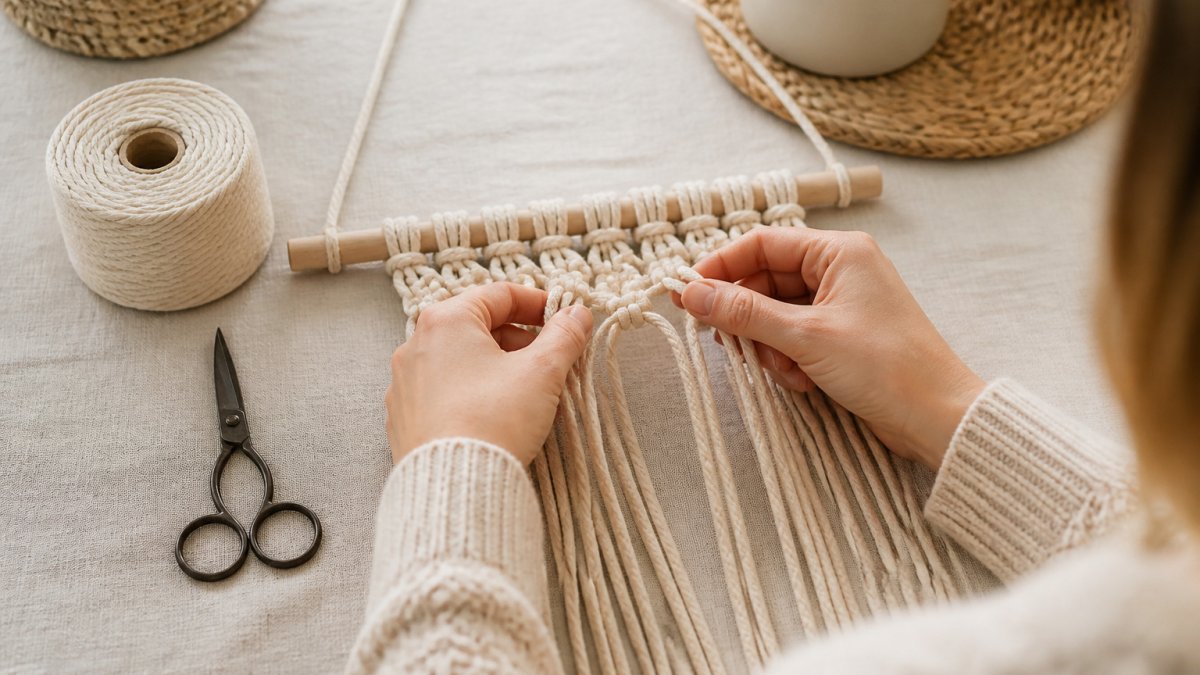
- Cut your cords. Cut eight cords, each about 10 feet long. Cutting them all the same length keeps your finished piece even.
- Attach the cords to the dowel. Fold each cord in half and loop it over the dowel. Pull the two ends through the loop and tighten. Space the cords evenly across the dowel.
- Work a row of square knots. Take four cords at a time and tie square knots across them. Work from one side to the other until you reach the end of the row.
- Add a second row. Leave a small gap below the first row, then tie another row of square knots. Keep the gap the same size each time.
- Finish with a flat or fringed bottom. You can trim the ends evenly for a clean look, or leave them long for a fringe.
- Check the balance. Hold the piece up and look for loose or uneven knots. Adjust them now, before you hang it.
Watch out: Pulling knots too tight makes the hanging puckered and stiff. Keep each knot firm but not strained, and let the cord slide freely through your fingers.
| Step | Time Needed | Key Tip |
|---|---|---|
| Cut cords | 10 minutes | Keep all lengths equal |
| Attach to dowel | 20 minutes | Space cords evenly |
| First row of knots | 45 minutes | Keep tension steady |
| Second row | 45 minutes | Match your gap |
| Trim and finish | 15 minutes | Trim ends evenly |
Finishing, Trimming, and Caring for Your Cotton Piece
When your knots are complete, trim the bottom ends neatly. For a fringe look, leave the ends long. For a clean edge, trim them to the same length and apply a small dot of fabric glue to stop fraying.
Cotton cord is simple to care for. Dust it with a soft brush or a hand-held vacuum on a low setting. If it gets dirty, spot-clean with a damp cloth and mild soap, then let it air dry flat. Do not soak it, and avoid machine washing, which can tangle and shrink the knots.
Store extra cord in a dry place away from direct sunlight. Cotton can yellow over time when left in strong light.
How to Hang a Macramé Wall Hanging Safely
A finished wall hanging should sit flat, stay put, and never pull on the wall. Use a hanging hook or a sturdy wall anchor rated for the weight of your piece. A lightweight wall hanging usually needs only a single small nail. Heavier pieces, or pieces with a dowel full of decorations, need a stud or a proper anchor.
Before you hang your piece, check the wall. Make sure no pipes or wires run behind the spot where you plan to drill or nail. Measure the position so the piece lines up with your furniture.
Test the load before you trust it
A simple load test helps you hang with confidence. First, weigh your finished piece on a kitchen scale. Then hang it from its intended hook and gently pull down with about twice the piece's weight for a few seconds. If the hook, anchor, or dowel shifts, move to a stronger anchor or a stud. A single small nail holds only a light load, so use a wall anchor rated above your piece's weight. Check the hanging point again after a week, since knots can settle and shift slightly.
Outdoor use: what cotton can and cannot handle
Cotton is a indoor fiber at heart. In rain, persistent humidity, or direct sun, cotton cord absorbs moisture, can grow mildew, and weakens over time. A covered porch with no direct rain may work for a season, but a piece fully exposed to weather will not last. If you want an outdoor hanging, choose a weather-resistant cord or plan to bring the piece inside during wet or very sunny stretches. For bathrooms and sunny windows, keep cotton pieces away from direct moisture and strong light.
If you plan to hang a piece in a humid bathroom or near a window with strong sun, keep it away from those spots. Moisture and heat can weaken cotton over time. Keep cotton pieces indoors, away from steady damp and direct sun.
Start Your First Wall Hanging With Stitched Creations Supplies
Stitched Creations makes premium, small-batch handmade crochet and macramé pieces, crafted with eco-friendly materials. If you would like to see finished pieces before you begin your own, browse our handmade collection.
Our pieces are crafted with hands and heart to bring warmth and style to your everyday life. If you enjoy the finished look, you might also like our handmade pieces. Pricing depends on the piece, quantity, and delivery details, so check our website for current prices or request a quote. Shop Now with Stitched Creations and start your first wall hanging this week.
Frequently Asked Questions
What natural fibers are best for beginner wall hangings?
Natural cotton cord is the most forgiving choice for a first wall hanging. It is soft on the hands, easy to knot, and holds its shape well when you pull each knot tight. Jute is stiffer and more textured, which can make beginner knots harder to control. Cotton in a 3 mm to 4 mm thickness gives you a good balance of visibility and manageability. Stitched Creations offers handmade pieces made with eco-friendly materials.
What supplies do you need to make a natural fiber wall hanging?
You need natural cotton macramé cord, a wooden dowel or branch for the top bar, scissors, a tape measure, and a clipboard or clip to hold your work. A few sewing pins or clothespins help keep cords in place while you knot. Buy a little extra cord in case of mistakes. Exact quantities depend on your design, so measure your planned length before cutting.
What is the easiest knot for a beginner macramé wall hanging?
The square knot is the easiest and most useful knot to learn first. You tie it with four cords, passing the outer cords around the middle two, and it forms the basic building block of most wall hangings. Once you can tie square knots evenly, add the half-knot spiral for texture. Practice on a short length of cord before starting your full project so your tension stays consistent.
How do you hang a natural fiber wall hanging safely?
Use a sturdy wooden dowel or branch, and check that your wall anchor is rated for the weight of your piece plus the dowel. Cotton is lightweight, so most small hangings need only a standard hook, but heavier pieces with thick cord need a stronger anchor. Hang the piece away from direct sun and damp areas, since moisture and prolonged sun exposure can weaken natural fibers over time.