 how-to
How to Calculate Yarn Yardage for Crochet
Table of Contents
- Why Calculating Yarn Yardage Matters for Your Crochet Projects
- Understanding Yarn Labels and Specifications
- Weighing Yarn to Calculate Yardage: The Foundation Method
- The Math Formula: Converting Grams to Yards
- Yarn Weight vs Yardage: Understanding the Relationship
- Using a Crochet Yardage Calculator and Tools
- Accounting for Tension, Gauge, and Fiber Type Variations
- Estimating Yardage for Specific Crochet Project Types
- Frequently Asked Questions
Last Updated: September 30, 2026
Why Calculating Yarn Yardage Matters for Your Crochet Projects
Getting yarn yardage right is the difference between finishing a project and running short halfway through. When you calculate yarn yardage accurately, you avoid the frustration of abandoned sweaters, incomplete blankets, or having to hunt down discontinued yarn months later.
At Stitched Creations, we work with yarn daily to craft handmade pieces. We've learned that understanding how much yarn you actually have determines whether your project succeeds or stalls. This matters whether you're following a published pattern or designing your own work.
The challenge is that yarn labels don't always tell the full story. A ball band shows weight and yardage for a fresh skein, but what happens when you're using partial balls? What if you're substituting yarn? How do you account for the yarn you'll lose to tension changes or blocking? These questions trip up even experienced crocheters.
This guide walks you through the exact methods to calculate yarn yardage in any situation. You'll learn how to weigh yarn, use formulas, account for fiber differences, and estimate requirements for different project types.
Understanding Yarn Labels and Specifications
What Information Your Ball Band Provides
Your yarn label is packed with data. The ball band tells you weight (in grams or ounces), yardage (or meters), fiber content, recommended hook size, and care instructions. This information is your starting point for any yardage calculation.
The weight and yardage pairing is critical. A 100-gram skein might have 220 yards or 420 yards depending on the yarn type. Heavier, denser fibers pack less yardage into the same weight. Lighter, airier fibers stretch further. The label gives you both numbers so you can calculate how many yards per gram that specific yarn contains.
Keep your ball bands. They're your reference sheet. If you lose one, you lose the exact yardage information for that yarn, making it much harder to plan future projects with leftovers.
Yarn Weight Categories and Their Impact
Yarn comes in standardized weight categories. The Craft and Yarn Council defines these from lace (finest) through jumbo (thickest). Each category affects how much yardage you get per gram.
Lace and fingering weight yarns are thin and light. A 100-gram skein might contain 400+ yards. Worsted and bulky weights are thicker and denser. The same 100 grams might give you only 180 yards.
This matters because a pattern written for worsted weight won't work with bulky yarn, even if the yardage looks similar. The thickness changes how fast your project grows. A 1,000-yard worsted blanket and a 1,000-yard bulky blanket are very different sizes.
Understanding your yarn weight category helps you spot substitution problems before you start. It also explains why you can't just swap yarns by yardage alone, you need to match weight category too.
Weighing Yarn to Calculate Yardage: The Foundation Method
Tools You'll Need for Accurate Measurement
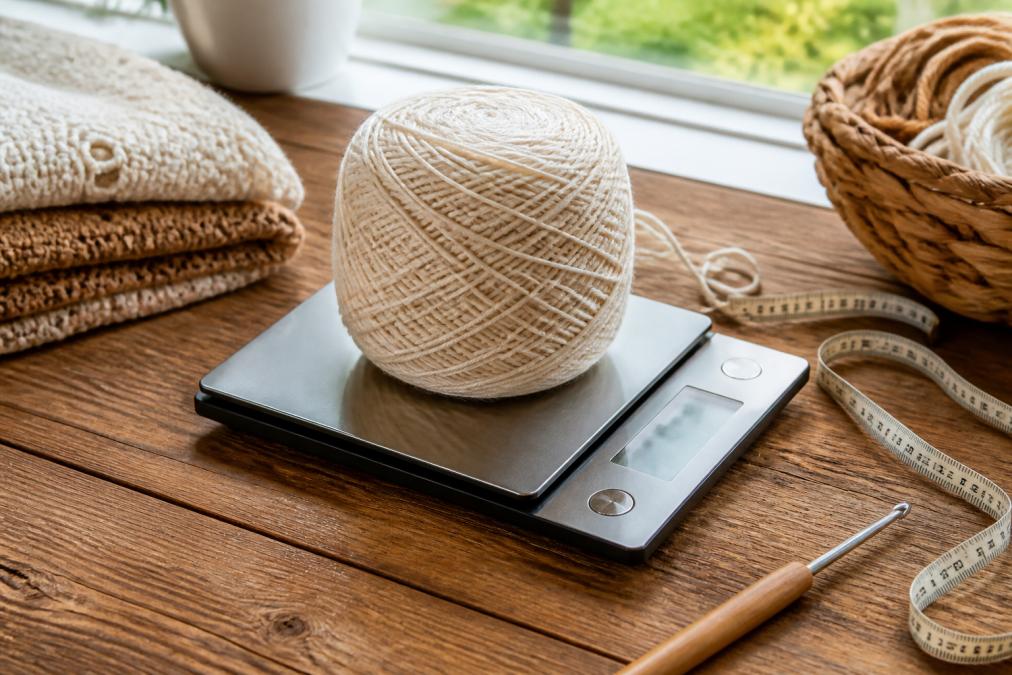
Accurate measurement requires the right tools. A kitchen scale is your foundation. Digital scales are faster and more precise than mechanical ones. Look for a scale that measures in grams and reads to at least 0.1-gram precision.
You'll also need:
- A digital kitchen scale (grams preferred)
- Measuring tape or yarn measuring tool
- Paper and pencil to record numbers
- A crochet hook or needle to help measure
- The original ball band from your yarn
Some people use a yarn meter or measuring wheel, but a simple tape measure works fine. The key is consistency, use the same tools each time so your measurements stay reliable.
Step-by-Step Process for Weighing and Converting
Here's how to find the yardage of yarn you have on hand:
Step 1: Weigh your yarn Place your yarn on the scale. Note the total weight in grams. If you're measuring a partial skein, weigh just that portion.
Step 2: Find the yardage-per-gram ratio from your ball band Your label shows total weight and total yardage. Divide yardage by weight. Example: 220 yards ÷ 100 grams = 2.2 yards per gram.
Step 3: Multiply your yarn's weight by the ratio Multiply the weight of yarn you have by the yards-per-gram number. Example: 85 grams × 2.2 = 187 yards.
Step 4: Account for waste Subtract 5-10% for weaving in ends and tension changes. In this example: 187 × 0.9 = 168 usable yards.
This method works for any yarn, any amount, any time. It's the most reliable way to know exactly what you're working with.
The Math Formula: Converting Grams to Yards
The formula is simple once you understand the pieces:
(Yarn Weight in Grams) × (Yards Per Gram) = Total Yards
To find yards per gram, use your ball band:
(Total Yardage on Label) ÷ (Total Weight on Label) = Yards Per Gram
Then plug in your numbers. If your yarn is 250 yards and 100 grams:
250 ÷ 100 = 2.5 yards per gram
If you have 120 grams of that yarn:
120 × 2.5 = 300 yards
This formula works because yarn density is consistent. The same yarn always contains the same amount of yardage per gram. The math never changes, only your input numbers do.
Most crocheters keep this formula simple: divide the label yardage by label weight, then multiply by what you have. Write it down and keep it handy.
Yarn Weight vs Yardage: Understanding the Relationship
Weight and yardage are not the same thing, and this confusion costs crocheters time. A 100-gram skein could be 200 yards or 500 yards depending on what yarn it is.
Weight tells you how heavy the yarn is. Yardage tells you how long it is. A thick, dense yarn weighs more for the same length. A thin, airy yarn weighs less for the same length.
This is why you can't estimate yardage from weight alone. You need both numbers from the label. The relationship between them, the yards-per-gram ratio, is what actually matters for your project.
When substituting yarn, match the weight category first (both should be worsted, or both fingering, etc.). Then check that the yards-per-gram ratio is similar. If one yarn is 2.0 yards per gram and your substitute is 3.5 yards per gram, they'll produce different fabric even at the same hook size.
Understanding this relationship saves you from buying the wrong yarn or discovering too late that your substitution won't work.
Using a Crochet Yardage Calculator and Tools
How Online Calculators Work
Online crochet yardage calculators automate the math. You enter your yarn weight in grams and the yards-per-gram ratio from your label. The calculator multiplies them and gives you total yardage.
Some calculators let you input multiple yarn weights and add them together. This is useful if you're combining leftover yarns for a project. Others estimate yardage needed based on project type and yarn weight category.
The best calculators are transparent about their math.
Calculating Yardage for Partial Skeins
Partial skeins are where yardage calculation proves its worth. You can't rely on the label anymore, you have to measure what you actually have.
Accounting for Tension, Gauge, and Fiber Type Variations
How Tension and Gauge Affect Your Yarn Consumption
Tension is how tightly or loosely you crochet. Gauge is the number of stitches and rows in a standard measurement (usually 4 inches). Tight tension means more stitches per inch. Loose tension means fewer.
Fiber Density and Its Role in Yardage Estimation
Different fibers have different densities. Wool, cotton, acrylic, and blends all behave differently. This affects how far your yarn stretches and how much yardage you get per gram.
Estimating Yardage for Specific Crochet Project Types
Blankets and Large Projects
Blankets demand the most yarn. A throw blanket typically needs 1,500-3,000 yards depending on size and stitch pattern. A full-size bed blanket needs 3,000-6,000 yards or more.
Wearables and Garments
Sweaters, cardigans, and shawls need less yarn than blankets but require more precision. A small sweater might need 800-1,500 yards. A large cardigan can need 2,000-3,500 yards.
Accessories and Small Items
Hats, cowls, scarves, and small bags need 100-800 yards depending on the item. These projects are forgiving because they're small enough to adjust as you go.
Frequently Asked Questions
How do I calculate the yardage of yarn using a kitchen scale?
Weigh your entire skein on a kitchen scale and note the grams. Check your yarn label for the total yardage and weight. Divide the total yardage by the total weight in grams to find yards per gram. Then multiply yards per gram by your partial skein's weight. For example, if a 100-gram skein contains 220 yards, that's 2.2 yards per gram. A 30-gram portion would be 66 yards (30 × 2.2).
What's the difference between yarn weight and yardage?
Yarn weight refers to thickness (fingering, worsted, bulky, etc.), while yardage is the actual length of yarn in a skein. Two skeins can weigh the same but have different yardages depending on fiber density. A 100-gram skein of bulky yarn might have 80 yards, while 100 grams of fingering weight could contain 400 yards. Always check both measurements on your ball band to plan projects accurately.
How many yards of yarn do I need for a standard crochet blanket?
A typical 50x60-inch crochet blanket requires 2,000-3,000 yards depending on stitch pattern and yarn weight. Granny square blankets use less yardage than single-stitch designs. Check your specific pattern for exact requirements, then add 10-15% extra for tension variations and mistakes.
Does crochet stitch type affect how much yarn I need?
Yes. Dense stitches like single crochet consume more yarn than open stitches like chains or shells. Complex stitch patterns with multiple yarn overs use more yardage than simple repeats. Always crochet a blocked swatch in your chosen stitch pattern, measure its area, then calculate how much yarn it consumed. This tells you the actual consumption rate for your specific project design.